

Men's Haircuts 2026: Complete Guide to Styles, History & Technique | SKRILOV
- Yan Skrilov

- Nov 14, 2024
- 13 min read
Updated: Jun 4
Men's haircuts in 2026 are defined by precise fades, textured crops, and the return of polished classics like the slick back, the Old Money side part and the flat top. This editorial guide breaks down twelve essential men's haircut styles — from timeless military cuts to subcultural statements — covering each style's heritage year, country of origin, technique, who it suits, and how to ask a barber for it anywhere in the world.

1. The Fade — Modern Classic | Origin: 1940s–50s, US Military
Category: Modern Classic. Heritage: born in 1940s–50s US military barbershops as a regulation taper for service members, the fade migrated into Black American barbering culture in the 1970s and 80s and became the dominant global men's cut by the 2010s.
Technique: barbers blend graduated clipper guards from #0 (skin) or #0.5 at the base up through #1, #1.5, #2 and #3, using lever play and clipper-over-comb to erase the lines between guards. The four heights are: low fade (tapers near the ear), mid fade (starts at the temple), high fade (above the temple) and skin fade or bald fade (zero-blade to bare skin). A razor finish around the hairline gives the sharpest edge.
Who it suits: every face shape and hair type. Pair with a textured crop, quiff, pompadour, slick back or natural curls. To ask: specify fade height (low/mid/high/skin) and shortest guard at the bottom.

2. The Textured Crop — Timeless Classic | Origin: Ancient Roman / Modern Revival 2010s
Category: Timeless Classic. Heritage: the cropped fringe has ancient origins — Roman legionaries and Caesar himself wore a forward-swept short crop. The modern French crop was revived through 2010s London barbering and is now globally signature thanks to footballers and grooming editorials.
Technique: scissor-over-comb on the top to keep the length between 2 and 4 cm with a choppy, broken fringe; sides taken down with a #1 or #2 clipper guard or a low taper fade. Point-cutting at the fringe creates the signature texture. Educationally: a matte clay holds the broken-up shape without shine, and a light sea salt spray applied to damp hair gives the fringe its lived-in separation before you finish with the clay.
Who it suits: fine to medium hair, oval and rectangular faces, and anyone managing a receding hairline — the forward fringe softens the temple line beautifully.

3. The Undercut — Retro Modern | Origin: 1920s Europe / Peaky Blinders Era
Category: Retro Modern. Heritage: the disconnected undercut traces to working-class Britain in the 1910s and 1920s — Birmingham gangs and post-WWI continental Europe — popularised globally by Peaky Blinders and 2010s editorial barbering.
Technique: unlike a fade, the undercut is a hard disconnect. Sides and back are clipped to a single uniform short length (typically #2 or #3 all over), with no taper, while the top stays long — usually 8–15 cm. The line of disconnect sits anywhere from above the ear to the temple. Top is finished with pomade and combed back or to a side part.
Who it suits: thick straight or wavy hair, square and oval faces. Requires a trim every three to four weeks to keep the disconnect sharp.

4. The Pompadour — Rock'n'Roll | Origin: 1950s USA, Elvis Presley
Category: Rock'n'Roll Classic. Heritage: named after Madame de Pompadour in 18th-century France, the men's version was immortalised by Elvis Presley and 1950s American rockabilly culture, then refreshed for the 2010s by David Beckham and Bruno Mars.
Technique: top hair grown to 10–13 cm, swept up and back into a rounded peak above the forehead. Sides are tapered or fade-finished — usually a #1 or #2 taper with a defined parting line, sometimes razor-etched. A blow-dryer with a paddle brush builds the lift; a matte pomade or strong-hold styling clay holds the form. A defined side part finishes the modern, cleaner 2026 version.
Who it suits: oval and square faces, thick straight hair. Signals theatricality, confidence and old-school polish.
5. The Modern Mullet — Rebellion Revival | Origin: 1970s USA & UK / 2020+ Global Revival
Category: Rebellion / Subcultural Revival. Heritage: the mullet was born in 1970s rock and rebel culture — David Bowie, Paul McCartney, then country and metal in the 80s. It carried a stigma through the 90s and 2000s before returning forcefully in 2020 via TikTok, Australian football culture and European tennis players.
Technique: the 2026 modern mullet keeps the short-top long-back silhouette but cleans it up. Top is scissor-cut to 4–6 cm with texture; sides are taper-faded (low or mid taper, #1 or #2 guard) rather than buzzed; the back tail is left at 8–15 cm, shaped with point-cutting; a curtain or wispy fringe sits up front. The disconnect is soft, not severe.
Who it suits: straight to wavy hair, any face shape with attitude. Tennis players, footballers and Gen Z global culture have made it instantly readable.

6. The Buzz Cut — Military Classic | Origin: 20th-Century Armed Forces
Category: Military Classic. Heritage: standard regulation cut across most 20th-century armed forces — the US Marine Corps high-and-tight, the British Army induction, the Soviet призывник. It moved into civilian fashion through Steve McQueen, Bruce Willis and post-2000 minimalist style.
Technique: a single clipper guard run over the entire head for a uniform length. The induction buzz uses a #0 or #1 for maximum minimalism; the standard buzz uses #2 or #3; the burst buzz leaves slightly more on top (#3 or #4) for subtle shape. A defined hairline edge with a trimmer or straight razor elevates the look. Maintenance interval: 2–3 weeks.
Who it suits: strong jawlines and well-shaped skulls, all hair textures, and anyone managing thinning hair. One of the lowest-maintenance cuts you can choose — but because it sits flush to the head, it exposes skull shape: run a hand from crown to nape in front of a mirror, and if you find pronounced flats or asymmetries, ask your barber for a #2 or #3 burst buzz rather than a #0 induction.

7. The Quiff — Rock'n'Roll Modern | Origin: 1950s UK Teddy Boys
Category: Rock'n'Roll. Heritage: the quiff emerged in 1950s Britain among Teddy Boys, fusing American pompadour influence with European tailoring. It dominated post-punk 1980s style (Morrissey, A-ha) and was modernised by David Beckham and Zayn Malik in the 2010s.
Technique: medium top length (5–8 cm), swept up and slightly back into a relaxed, lived-in finish — less sculpted than a pompadour, more shaped than a crop. Sides are tapered with a #1 or #2 guard or low-faded. Sea-salt spray pre-styling adds grit; matte paste finishes. Blow-dry top forward then back for natural lift.
Who it suits: most hair types, comes alive on thick or wavy hair. The safe choice when you want personality without committing to a statement cut.
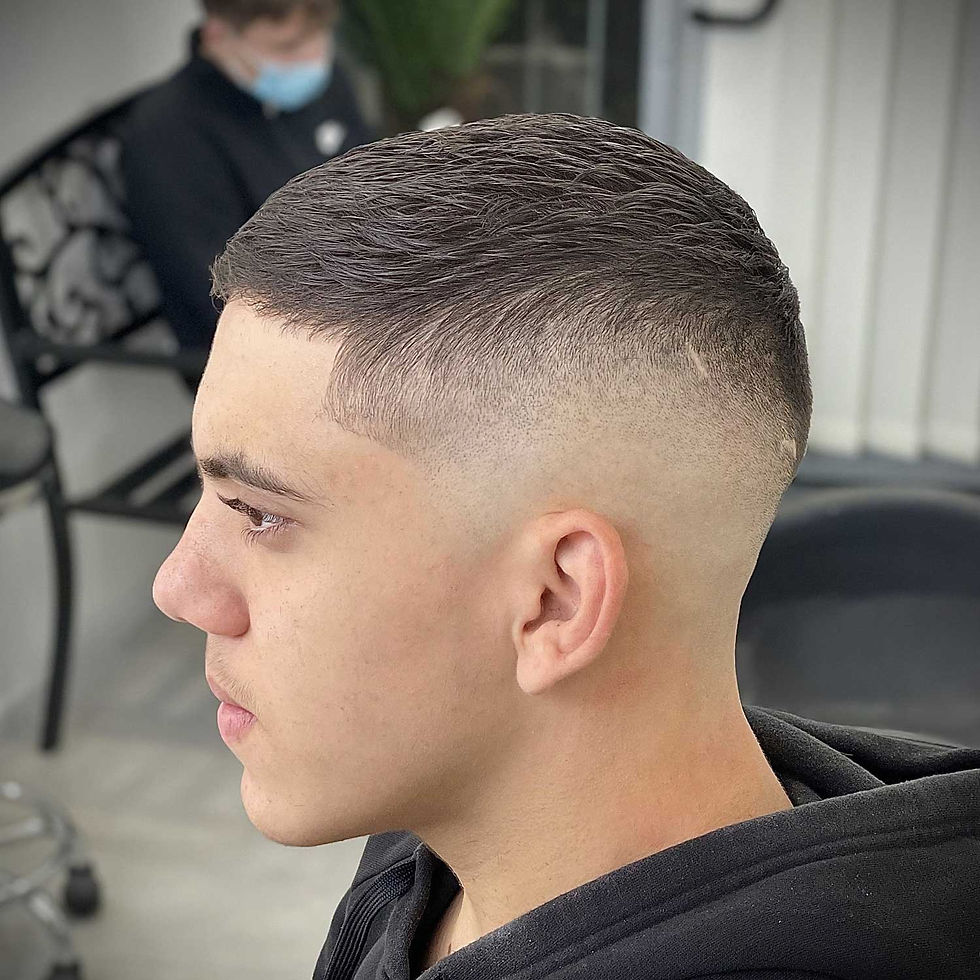
8. The Old Money Side Part — Quiet Luxury | Origin: 1920s–50s Ivy League / TikTok 2024 Revival
Category: Quiet Luxury. Heritage: the Ivy League / preppy side part is rooted in 1920s–50s American East Coast university style — Princeton, Harvard, Yale — and the European aristocratic look. It re-entered global culture in 2024 through TikTok's Old Money aesthetic, alongside cashmere knitwear and tennis whites.
Technique: clean scissor work on top — no clipper guards — building a controlled, deliberate shape rather than relying on length removal. Medium length (5–8 cm), parted on one natural side and combed flat with a slight sweep. Sides are scissor-tapered short but never buzzed and never faded, so the silhouette stays soft and refined. A light glossy pomade or hair cream gives controlled shine. Maintenance: every 4–5 weeks.
Who it suits: oval and rectangular faces, straight to slightly wavy hair, and anyone whose dress code includes tailored wool and suede. Signals discretion, education and quiet confidence.

9. The Slick Back — Retro Power | Origin: 1920s USA, Gatsby Era
Category: Retro Power Classic. Heritage: the slick back belongs to 1920s American gangster and Gatsby-era style — Al Capone, Lucky Luciano — codified by Hollywood through Pacino, De Niro and Christian Bale's American Psycho. A perennial power-dressing signal.
Technique: medium-to-long top (8–12 cm) combed straight back from the forehead. Sides can be tapered with a #2 guard for the classic version or kept disconnected with an undercut for the modern aggressive variant. Wet-look gel or a glossy pomade applied through damp hair; a fine-tooth comb sets the lines. Re-style daily.
Who it suits: medium to thick straight hair, oval and square faces. Pairs with tailored suits, leather jackets and any context where authority matters.

10. The Edgar Cut & Curtains — Urban Modern | Origin: 2020s Mexican-American / 90s Curtains Revival
Category: Urban Modern / Gen Z. Heritage: the Edgar (also called takuache) emerged from Mexican-American barbering culture in the southern US and went viral in the 2020s. Curtains, the parallel style, revive the 1990s middle-parted fringe of Leonardo DiCaprio and Brad Pitt.
Technique: the Edgar is defined by a straight, blunt horizontal fringe cut across the forehead, with sides taken down to a low or mid skin fade and a sharp lined edge at the hairline. Top is short to medium (3–5 cm). Curtains keep slightly more length (6–10 cm) parted in the centre or off-centre and swept symmetrically to each side, with a softer taper and natural fringe drop.
Who it suits: Gen Z and millennial men with straight to wavy hair; both work on oval, round and heart-shaped faces. Currently the most-requested style category in global teen and twenties barbering.
11. The Flat Top — Aggressive / Military | Origin: 1950s US Military, 1980s–90s Hip-Hop Revival
Category: Aggressive / Military Modern. Heritage: the flat top was born in 1950s US military service barbershops — Marine Corps and Air Force regulation — and was reimagined in the 1980s and 90s as a defining hip-hop, R&B and Black American style icon. Will Smith in The Fresh Prince of Bel-Air, Grace Jones, and Kid 'n Play wore the flat top to cultural prominence. The high-top fade is its tallest variant.
Technique: hair is grown vertically on top to a uniform 4–10 cm, then cut perfectly flat across the top using a clipper-over-comb method with the comb held horizontally — the barber must visually correct the curvature of the skull to create a perceived flat plane. Sides are taken down with a fade (#0 to #2). A boar-bristle brush and styling powder or pomade train the hair to stand. The squared horizontal silhouette is the defining feature.
Who it suits: thick coarse hair, especially Afro-textured hair where the cut originated. Square, oval and diamond faces. A high-effort, high-impact statement cut requiring a trim every 2–3 weeks.
12. The Mohawk — Subculture | Origin: 1970s UK & USA Punk
Category: Subculture / Fashion Revival. Heritage: the modern mohawk takes its name from the Mohawk Nation but its global form was forged in 1970s London and New York punk — Sex Pistols, The Clash, CBGB — as the most visible signal of subcultural rebellion. David Beckham wore a softer version in 2002 and athletes and runway models have kept it in rotation since.
Technique: classic punk mohawk takes the sides down to skin with a #0 guard or a straight razor, leaving a vertical strip of hair 5–10 cm wide running from forehead to nape, grown long enough (10–20+ cm) to be lifted into spikes with hairspray and egg-white or strong gel. The faux-hawk (fohawk) is a softer modern variant: sides faded rather than shaved, top kept at 6–8 cm and styled upward into a soft ridge without full commitment.
Who it suits: anyone wanting a statement of individuality. Works best on straight to slightly wavy hair. The faux-hawk version suits broader professional contexts; the full mohawk remains a fashion and music-scene signature.
Men's Haircut FAQs — 2026 Editorial Guide
What is the most popular men's haircut in 2026?
The mid fade with a textured crop on top is consistently one of the most globally requested men’s haircuts in 2026, while the Old Money side part and the modern mullet have grown fastest in barber search data over the past year. A mid fade with 5–7 cm on top, styled with a matte paste, tends to be one of the most universally flattering options across face shapes and hair types.
What's the difference between a fade and an undercut?
A fade is a graduated taper — the sides blend smoothly from short stubble at the bottom to longer hair on top through multiple clipper guards (#0 through #3). An undercut is a hard disconnect — sides are clipped to one uniform short length with no taper, creating a visible step between the short sides and the long top. Fades read modern and clean; undercuts read editorial and bold.
Which haircut suits oval, square, round and heart face shapes?
Oval faces suit almost every style and are the most versatile. Round faces look sharper with height and tighter sides — pompadour, quiff or high fade with a textured crop. Square faces are flattered by softer shapes — curtains, slick back, side part or natural curls. Heart-shaped faces (wider forehead, narrow chin) benefit from medium length with side-swept volume — quiff, curtains or Edgar. Long or rectangular faces benefit from volume on the sides and shorter on top — buzz cut, crew cut or fringe-forward Edgar.
What's the name of the cut with short sides and long top?
If the transition is a gradient, it is a fade — combined with whatever style is left on top (fade + crop, fade + quiff, fade + pompadour). If the transition is a hard line with no blend, it is an undercut. If the sides are uniform and slightly longer, scissor-cut rather than clipped, it is a side part or a classic short-back-and-sides. The term 'short sides, long top' is descriptive rather than a single named cut — always specify fade, undercut or scissor-taper when speaking to a barber.
How does the modern mullet differ from the 1970s original?
The 1970s original mullet was severe — heavily layered, often permed, with a stark unblended transition between short top and long back, worn with maximum length and minimal grooming. The 2026 modern mullet is technically refined: the sides are taper-faded (not buzzed), the back tail is sculpted with point-cutting rather than chunky layers, the disconnect between front and back is soft, and a curtain or wispy textured fringe replaces the hard 70s top. The silhouette echoes the original but the execution is closer to a contemporary scissor cut.
What is the Old Money haircut style and who does it suit?
The Old Money haircut is a refined scissor-cut side part: medium length on top (5–8 cm), parted naturally on one side, combed flat with a slight sweep, sides kept short but never faded or buzzed. It is rooted in 1920s–50s Ivy League American style and European aristocratic grooming, and was reborn through TikTok's 2024 Old Money aesthetic. It suits oval and rectangular face shapes, straight to slightly wavy hair, and anyone whose wardrobe includes tailored wool, cashmere knitwear and discreet leather goods — it signals quiet confidence, education and understated taste.
Beyond the trend names: how a barber actually chooses
Face shape and lifestyle matter more than trend names. A high skin fade looks dramatic on a magazine cover, but if you sit at a desk under fluorescent lights five days a week and only get to a barber every six weeks, a low or mid taper will look cleaner for longer — the regrowth blends back into your natural hairline instead of forming a visible line that telegraphs ‘overdue’ at week three. Ask yourself how often you can realistically sit in a chair, then choose the shortest part of the cut accordingly.
Low or mid taper vs high skin fade — why it matters for upkeep
A low or mid taper keeps a soft graduated edge that thickens as it grows out, so the silhouette stays in shape for four to six weeks. A high skin fade exposes scalp at the temple and parietal ridge, and the moment hair starts to push through, the contrast line you paid for disappears. If your routine allows a touch-up every two to three weeks, a skin fade is rewarding; otherwise a mid taper gives a much higher percentage of good-looking days between cuts.
Why the textured crop works for thinning hair or a receding hairline
The textured crop is one of the most forgiving cuts for thinning crowns and receding temples. The forward-swept fringe physically covers the temple recession and breaks up the front hairline so the eye reads texture instead of scalp. The short broken length on top also avoids the optical trap of longer styles, where wisps separate and reveal where density has dropped. If you’re seeing more scalp in the mirror than you did a year ago, ask for a French or textured crop with a low taper rather than a longer pompadour or slick back.
Buzz cut and skull shape — how to assess yours before the chair
A short buzz sits flush to the head, which means it reads the skull rather than the hair. Stand in front of a mirror with side lighting, push your hair down flat and look for flats on the back of the head, sharp ridges above the ears, or an asymmetric crown. A pronounced flat or asymmetry will be much more visible at a #0 or #1 than at a #3 or #4. The fix is rarely dramatic: ask your barber for a slightly longer burst buzz (#2–#3) or a soft taper that leaves a millimetre more length over the visible flat, and the shape will read balanced.
Face shape and hair type — recommended cuts and what to avoid
Use this as a starting filter, not a verdict — a good barber will adjust to growth patterns, density and lifestyle. Each line follows the same format: Recommended · Avoid.
Round face — Recommended: High or mid fade with a textured crop, quiff, or pompadour — anything that adds vertical height and tightens the sides to lengthen the face visually. Avoid: Buzz cuts at uniform short length, flat shapes with no top volume, and longer flat side-swept styles that widen the cheek line.
Oval face — Recommended: Almost any style works — slick back, side part, undercut, textured crop, fade with crop, mullet. The most versatile shape. Avoid: Very heavy bowl-shaped fringes that cover too much of the face and flatten the natural proportions.
Square face — Recommended: Softer silhouettes — curtains, classic side part, Old Money scissor cut, slick back, or natural curls. Softens a strong jawline rather than echoing it. Avoid: Severe high skin fades plus boxy flat tops on the same head, which can read aggressive on an already angular face.
Elongated / rectangular face — Recommended: Volume on the sides and shorter on top — short buzz, crew cut, fringe-forward Edgar, or a French crop with a low taper. Adds horizontal width. Avoid: Tall pompadours and high quiffs, which stretch the face further; long top styles that hang down past the brow.
Heart-shaped face — Recommended: Medium length with side-swept volume — quiff, curtains, Edgar, or a soft side part. Balances a wider forehead against a narrower chin. Avoid: Tight high fades with very short tops, which expose the forehead and exaggerate the heart shape.
Fine hair — Recommended: Textured crop, French crop, crew cut, or buzz cut. Short shapes look denser than long ones. Educationally, styling powder applied at the root before a paste creates volume without weighing strands down. Avoid: Long slick backs and pomade-heavy styles that flatten strands to the scalp and reveal density loss.
Curly or wavy hair — Recommended: Curly top with a taper or low fade, modern mullet, longer quiff, or a controlled grown-out side part. Shapes that let curl pattern breathe rather than fighting it. Avoid: Hard disconnects on tightly curled hair without a transition, and heavy gels that fight the curl rather than defining it.
Styling, in plain language
Treat products as tools that match a finish, not as promises. None of these will grow hair or change your hairline — they shape what you already have.
Matte clay — for textured looks (crop, quiff, modern mullet). A pea-sized amount warmed between the palms and worked through dry or towel-dry hair holds separation without shine.
Styling powder — for fine hair. A light dusting at the root before styling adds grip and volume, especially under a crop, crew cut, or quiff.
Sea salt spray — for natural texture. Spray on damp hair and scrunch to encourage waves, separation and lived-in finish. Pairs well with a textured crop or modern mullet.
Heat protectant — before any blow-drying. A light mist on damp hair reduces friction and dryness when you use a dryer to set a quiff, pompadour, or slick back.
On scalp care: use a gentle shampoo suited to your hair type rather than chasing a label. Wash often enough to keep the scalp clean — that comfort and cleanliness is what good grooming feels like, not a medical claim about growth.
Read it, try it, repeat. For more guides like this one, follow SKRILOV’s global editorial team. Editorial direction by SKRILOV, Nof HaGalil.


If you’re looking to stay ahead of men’s haircut trends, it’s essential to choose a barber who truly understands modern styles and techniques. This website Five Star Barber Brand offers expert haircuts tailored to your personality and lifestyle, keeping you looking sharp and on-trend. From classic fades to contemporary textured cuts, their team ensures you get the perfect style every time. For a haircut that reflects the latest trends while matching your personal style, Five Star Barber Brand is the place to go.